
Choosing the right FPV frame geometry is one of the most important decisions when building a drone - it determines how the drone flies, how it tunes, and how clean your footage will be. This guide covers all major geometry types in 2026: True X, Squished X, Stretch X, Deadcat, H-frame, and Micro/Toothpick - with clear recommendations for every flying style.
Frame geometry is physics, not just aesthetics
Frame geometry describes the arrangement of motors and arms relative to the center of the drone. Every design choice here has direct physical consequences that affect your flying experience:
1 Moment of Inertia (MOI)
MOI determines how quickly the drone rotates around each axis. A wider frame increases roll MOI (slower, more stable rolls), while a shorter front-to-back axis reduces pitch MOI (snappier flips). Geometry is the single biggest factor in how a drone "feels" - before you even touch the tune.
2 Thrust symmetry
In a perfectly symmetrical frame (True X), all four motors contribute equally to pitch and roll. Asymmetric geometries (Deadcat, H-frame) create unequal leverage - which is a deliberate trade-off, not a flaw, when done right.
3 Propeller visibility in the shot
The position of the front motors relative to the camera FOV directly determines whether you see propellers in your footage. This is the entire reason the Deadcat geometry exists.
4 Tuning behaviour
Symmetrical MOI (True X) means pitch and roll tune similarly. Asymmetric frames may need separate axis tuning. Prop wash sensitivity also varies significantly with geometry.
5 Space for electronics and camera systems
The rise of larger digital camera units (DJI O3/O4, Walksnail Avatar Pro) has directly influenced frame design in 2025–2026. Geometry affects how much room you have at the front for mounting, vibration isolation, and cable routing.
All major FPV frame geometries at a glance
| Geometry | Clean shot? | Flying feel | Ideal for |
|---|---|---|---|
| True X | ⚠️ Props often visible | Symmetrical, precise, balanced | Racing, freestyle |
| Squished X | ⚠️ Partially / depends on camera | Snappy, lower pitch MOI, "lively" | Freestyle, race |
| Stretch X | ⚠️ Props often visible | Stable at speed, excellent prop wash resistance | Racing, fast freestyle |
| Deadcat | ✅ Typically clean shot | Smooth, cinematic, slightly less agile | Cinematic, DJI O3/O4, cinewhoop |
| H-frame | ⚠️ Props often visible | Stable, high inertia, slower response | Long range, heavy lifters |
| Micro / Toothpick | ✅ Often clean (depends on tilt) | Ultra-light, quick, playful | Sub-250g, indoor, park flying |
Note: Propeller visibility also depends on FOV width, camera tilt angle, frame size, and mount used.
Which geometry is right for you?
Stretch X or True X
Stretch X for high-speed stability and prop wash resistance. True X for maximum symmetry and easy tuning.
Racing frames →Squished X or True X
Squished X for a snappier, more agile feel. True X for balanced and predictable response.
Freestyle frames →Deadcat
The only geometry that keeps props fully out of shot. Essential for DJI O3/O4 and Walksnail builds.
Cinematic frames →Deadcat / Ducted
Smooth stabilised flights, prop guards, clean footage. Ideal for indoor and tight spaces.
Cinewhoops →H-frame or Stretch X
H-frame for maximum electronics space. Stretch X for a more modern long-range freestyle feel.
Long range →Micro / Toothpick
Under 250g, EU-friendly, easy to fly in parks and indoors. Great first FPV build.
Micro builds →True X - symmetrical classic
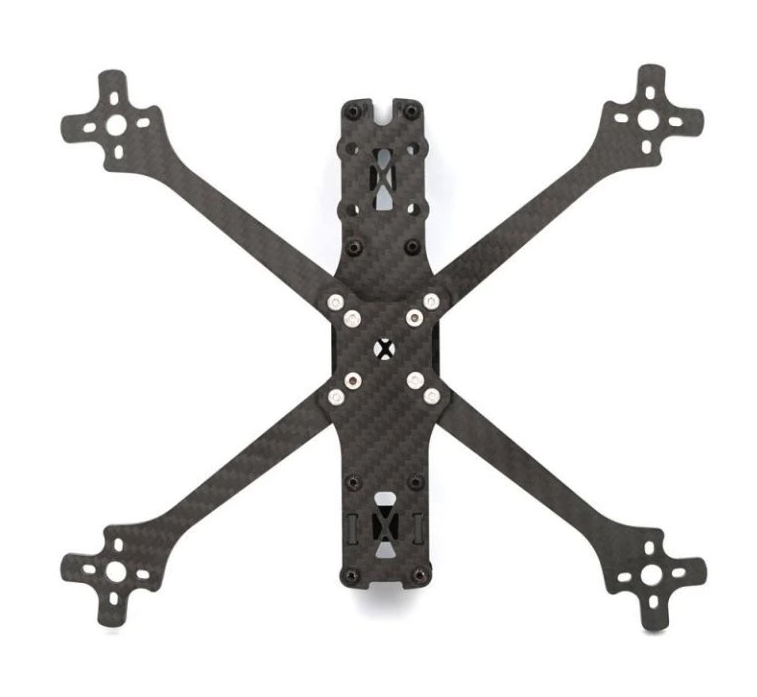
True X means all four arms are the same length and the motors form a perfect square. This gives you fully symmetrical thrust and MOI - the drone responds identically in pitch and roll, which makes it predictable and pleasant to tune.
| Characteristic | True X |
|---|---|
| MOI symmetry | Pitch = Roll - fully balanced |
| Prop wash resistance | Moderate |
| Camera visibility | Props often in shot at low camera angles |
| Tuning difficulty | Low - symmetric axes respond the same |
| Example frames | iFlight Nazgul5, GEPRC Mark4, TBS Source One |
Suitable for: racing, freestyle, pilots who prioritise tuning predictability and symmetry.
Squished X - compact and snappy
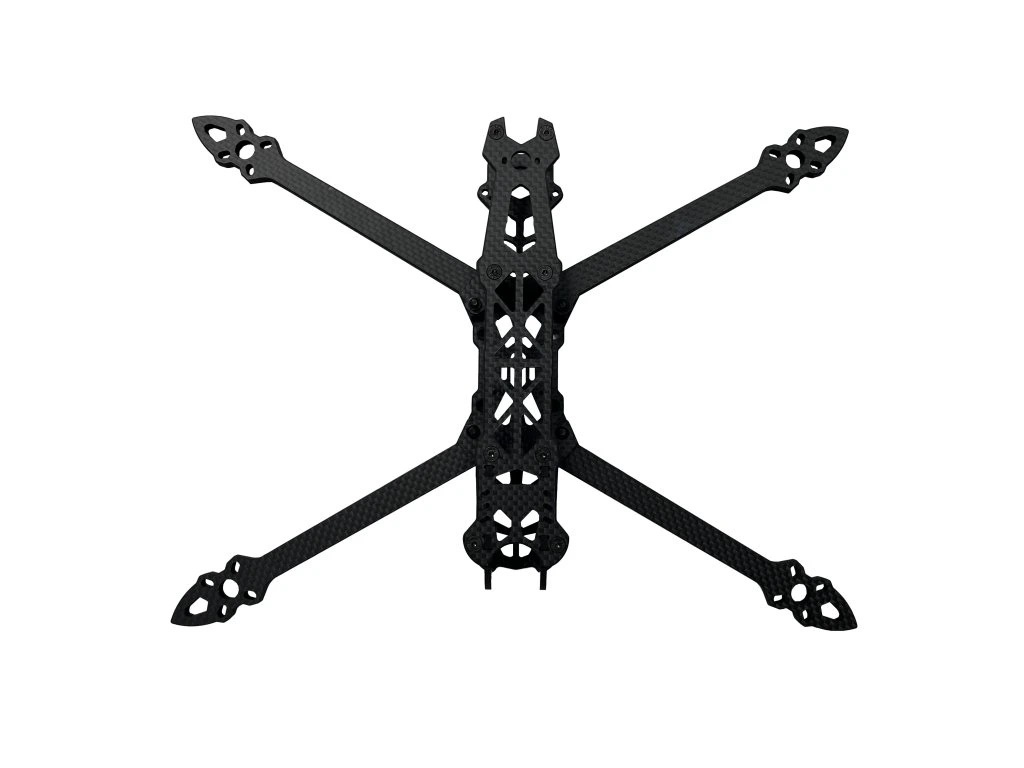
Squished X shortens the front-to-back axis while keeping similar width. The physics: a shorter pitch wheelbase reduces pitch MOI, meaning flips and direction changes happen noticeably faster. Roll MOI stays higher due to the wide stance, which adds stability in rolls. The result is a distinct "front-heavy agility" that many freestyle pilots prefer over True X.
| Characteristic | Squished X |
|---|---|
| MOI symmetry | Lower pitch MOI than True X - asymmetric |
| Prop wash resistance | Moderate |
| Camera visibility | Partially visible - depends on FOV and tilt |
| Tuning difficulty | Low–medium (pitch/roll may need separate tune) |
| Example frames | GEPRC Mark4, Diatone Roma F5 |
Suitable for: freestyle, racing (by preference), versatile all-round builds.
Stretch X - the modern choice for speed
Stretch X takes True X and extends the front-to-back axis - the result is a longer, narrower frame. It became the dominant racing geometry from around 2022 and remains the go-to choice in 2026 for anyone flying fast. Frames like the iFlight Nazgul Evoque and GEPRC Mark 5 popularised this layout.
The physics: a longer pitch wheelbase increases pitch MOI, which directly improves prop wash resistance - the biggest enemy of clean lines at speed. The drone feels planted through washes and high-speed gate sections where a True X would wobble.
| Characteristic | Stretch X |
|---|---|
| MOI symmetry | Higher pitch MOI - more stable in fast forward flight |
| Prop wash resistance | Excellent - best of the X geometries |
| Camera visibility | Props typically visible in shot |
| Tuning difficulty | Low–medium |
| Example frames | iFlight Nazgul Evoque, GEPRC Mark 5, Armattan Marmotte |
Suitable for: racing, fast freestyle, anyone dealing with prop wash issues on a True X build.
Deadcat - clean footage, built for digital
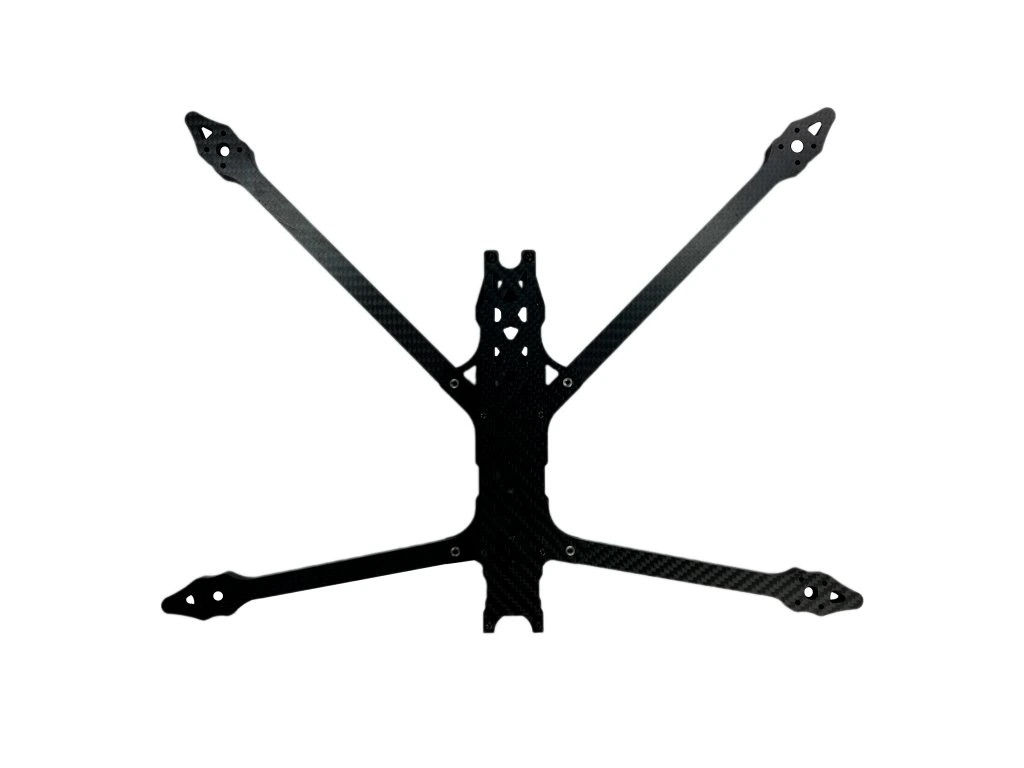
Deadcat geometry angles the front arms outwards - typically 30–40° from the lateral axis - so the front propellers fall outside the camera's field of view. The rear arms stay in a more standard position. The result: completely clean footage without distracting props in the frame.
In 2025–2026, Deadcat design has evolved specifically around digital FPV systems. The larger camera units of the DJI O3 Air Unit, DJI O4, and Walksnail Avatar Pro need more front clearance and a wider nose - and Deadcat geometry provides exactly that. Many modern Deadcat frames (like the Partizan Rocky) are shaped specifically to accommodate these units with vibration isolation and cable routing built in.
| Characteristic | Deadcat |
|---|---|
| MOI symmetry | Asymmetric - front arms angled outwards |
| Prop wash resistance | Moderate |
| Camera visibility | ✅ Typically clean - no props in shot |
| Tuning difficulty | Medium - asymmetry needs attention on yaw |
| Example frames | Partizan Rocky 8 SE, iFlight Cidora SL5, GEPRC Cinelog |
Suitable for: cinematic FPV, content creation, DJI O3/O4 and Walksnail builds, cinewhoop-style filming.
H-frame - long range and heavy lifters
The H-frame (also called H-quad) mounts all four motors at the ends of two parallel horizontal arms. It is one of the oldest quadcopter layouts but remains relevant in 2026 for specific use cases where a large, flat central platform matters more than agility.
| Characteristic | H-frame |
|---|---|
| MOI symmetry | High MOI in all axes - stable, slow to respond |
| Prop wash resistance | Low–moderate |
| Camera visibility | Props usually visible in shot |
| Tuning difficulty | Medium (higher inertia needs different PID approach) |
| Example frames | Various long-range and DIY GPS builds |
Suitable for: long-range FPV, GPS-heavy builds, aerial survey, professional payload work.
Micro / Toothpick - sub-250g and ultralight builds
The Toothpick and micro frame category (typically 2.5"–3.5" props) has exploded since EU and global sub-250g drone regulations created a strong incentive to build light. These frames adapt True X or Stretch X geometry at a much smaller scale - ultra-thin arms, minimal material - to hit the weight target without sacrificing rigidity.
| Characteristic | Micro / Toothpick |
|---|---|
| Typical prop size | 2.5" – 3.5" |
| Target weight | Under 250g (EU A1 category) |
| Camera visibility | Often clean depending on camera tilt |
| Tuning difficulty | Low–medium (modern AIO FCs simplify setup) |
| Example frames | BetaFPV Pavo25, GEPRC TinyGo, various DIY toothpick builds |
Suitable for: beginners, indoor/park flying, sub-250g regulatory builds, travel setups.
Which geometry to choose in 2026
| Flying style | Recommended geometry | Why? |
|---|---|---|
| 🎥 Cinematic / DJI O3/O4 / Walksnail | Deadcat | Prop-free shot, space for digital camera units |
| 🏁 Racing | Stretch X | Best prop wash resistance, stable at speed |
| 🕹 Freestyle (snappy) | Squished X | Lower pitch MOI, agile feel |
| 🕹 Freestyle (balanced) | True X | Symmetrical, easy to tune |
| 📡 Long range / GPS | H-frame or Stretch X | Electronics space vs. modern feel |
| 🪶 Sub-250g / beginner | Micro / Toothpick | Light, fun, EU-friendly |
| 🎬 Cinewhoop / indoor | Deadcat / Ducted | Clean footage, prop protection |
Frame geometry is not a detail - it defines your flying experience and footage quality. The good news: once you understand the physics, the right choice becomes obvious for your use case.
Frequently asked questions
? What is the best FPV frame geometry in 2026?
There is no single best geometry - it depends on use case. For racing and fast freestyle, Stretch X is the current standard. For cinematic and DJI O3/O4 builds, Deadcat is the go-to. For general freestyle, True X or Squished X both work well depending on the feel you prefer.
? What is Stretch X and how does it differ from True X?
Stretch X extends the front-to-back axis compared to True X while keeping similar width. This increases pitch MOI, which improves prop wash handling and stability at speed. True X is fully symmetrical; Stretch X is elongated front-to-back. In practice, Stretch X feels more "planted" at speed, True X feels more evenly balanced in all axes.
? Deadcat or True X for DJI O3 / O4 builds?
Deadcat is the better choice for DJI O3 and O4. The angled front arms keep props out of the wide-angle camera FOV, and the wider nose naturally accommodates the larger DJI camera unit. True X will almost always show props in shot with a wide-angle lens at typical flying camera angles.
? Which geometry is easiest to tune?
True X is generally the easiest - pitch and roll MOI are equal, so adjustments transfer predictably between axes. Squished X and Stretch X have asymmetric MOI and may need separate pitch/roll tuning passes.
? What frame geometry should a beginner start with?
A Deadcat or Squished X in the 5" class works well for beginners who want clean footage or a fun freestyle feel respectively. A Micro/Toothpick in the 2.5"–3" class is a great option if you want to stay under 250g for less regulatory hassle and lower crash costs while learning.
Not sure which frame to pick?
Write to us and tell us what style of flying you want, what camera you use (GoPro / DJI O3 / O4 / Walksnail / analog), and what size drone you are building. We will recommend the right geometry and specific frame from our range.